How do I tune my Stromberg 97? Lucky knows.
 The Question for the Ages
“Can you tell me how to tune a Stromberg 97?” We get this question several times a week here at Lucky’s. It’s about the hardest one to answer. And the only person who can truly answer it is you. So please read this before you email us your full engine spec, zip code and cam timing sheet.
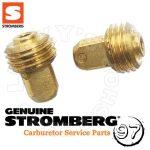
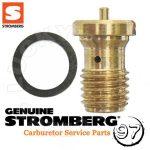
All Stromberg 97 come with 0.045 inch main jets and a Number 65 power valve for sea level use. With gasoline being not what it used to be, even single Stromberg carb applications can benefit from a change of main jet and and/or power valve for optimum running. Most multiple carb applications will certainly benefit, too.
Yet the selection of main jet and power valve sizes has never been trickier. Your local elevation, ambient temperature and humidity along with your engine combination (carb, intake, cam heads,etc.), your performance and economy expectations, and more, can all have a bearing on what jets are best, but the most important nowadays is your local gasoline formulation and quality. How to tune a Stromberg 97? It’s all but impossible for us to answer jetting questions accurately.
So Where Does That Leave You?
Our recommendation? Get the car running on what you’ve got (hopefully near factory jetting), then tune your jets by reading the plugs. If this is above your pay grade or get someone who knows your engine and Stromberg carbs where you live so you get the same gas, elevation etc. They can analyze the exhaust, read the computer and optimize it electronically. Ask other local 97 users what they use, too. Either way, there may well be some jet swapping along the way. We can provide some guidelines, but in the end, each application will be different.
When analyzing your mixture, remember Stromberg 97 main jets come in almost immediately when the throttle comes off-idle along with the fixed idle and transition ports in the base casting which control the mixture on their own up to about 50% throttle, then the power valve comes in, adding further fuel enrichment at the top end. So work on the main jets first. If you’re reading the spark plugs, start the main jet tuning by cruising at less than 50% throttle. Or just remove the carburetor accelerator pump links (flicking the spring off the pump fulcrum lever first) so the pump cannot open the power valve. Ride around with a clean stop. Then read the plugs. If you’re rich, go for smaller jets.
Then when you have the main jets dialed in, you can reconnect the springs and accelerator pump rods and give it a little more freeway speed – over 50% throttle, ideally without heavy acceleration so you don’t engage the accelerator pump discharge jets (squirt gas into the engine) if possible. That will allow you to see what is happening when the power valve adds enrichment at the top end. NOTE: Multiple carburetor systems end up with smaller power valves.
Local Gasoline Effects How You Tune A Stromberg 97
There are apparently at least 100 different gas formulations on sale in the US at any one time and it varies with altitude, the typical local temperature/humidity range (summer, winter etc), state laws, ethanol content (growing all the time) and other factors. In California, for example, there are many different formulas mandated by the local air quality authorities, and these are changed throughout the year. It is not a problem for modern engines as fuel injection automatically compensates. Carburetors don’t have electronic brains, but that is why we like them, right?
Blended fuel (high ethanol content) is another problem. Although the pump may not indicate that the fuel is blended, it is always advisable to verify the type of fuel the station carries (or stick to a station you know). Larger jets (a richer mixture) may help when running on fuels with high ethanol content. But, remember too that blended fuels are more volatile than gasoline, so difficult hot starting and poor hot weather drivability may result.
Stromberg 97 expert Jere Jobe once told us that his late model Ford Explorer V8, equipped with Montana smog devices averaged 23.5 miles per gallon on the highway on Montana gasoline. Under nearly identical conditions the same vehicle would average 17.5 miles per gallon on California gasoline. That fact alone says a lot about the efficiency of the various fuels. And why your hot rod feels like it has lost a cylinder when you drive out of State!
Altitude
As a rule, if you live at altitude, you need to look towards smaller jets and power valves because the air is thinner with less oxygen, so you need less fuel to maintain a good air/fuel mixture. Original Ford specification called for 0.043″ main jets for 5000-10,000ft, 0.041″ for 10,000 to 15,000 and …wait for it…0.039 for ‘15,000ft and over’!
How to tune a Stromberg 97 Variables
Higher capacity engines and those with bigger cams/higher volumetric efficiency will generally flow more air or flow the same air faster. So bigger jets may be required. Just remember though, that on the road you need low end drivability and that does not necessarily mean jetting for max top end power at the expense of everything else. Less power. More torque!
S or W?
Stromberg 97 and 81 carburetors (not 48) have Summer and Winter settings for the accelerator pump rod link (at the bottom end). This adjusts the volume of fuel squirted into the intake manifold if you accelerate quickly – W gives you more gas – but it should not change the idle setting nor the point at which the power valve is opened. Just be aware though that it can change the way your engine behaves on the road.
Changing Jets
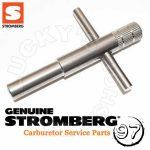
There is no easy way to change the jets in a Stromberg 97, 48, 40, 81 LZ etc. You get at them from underneath, so you are going to have to take the carbs off to do it. The power valves are replaced from the top – they are under the accelerator pump. You’ll find full instructions, with safety notes, under the ‘How To’ tab in our Tech Center for jets (9533k) and power valves (9594k). And here is a time-saving tip. Leave the carb base or bases fixed to the intake (so you do not disturb the linkage set-up), and just remove the three big screws that fix the bowl section to the base. Oh, and buy a Genuine Stromberg Premium Jet wrench (9071K). It’s the slickest Jet Wrench we’ve seen!
A Final Note
The art to Stromberg jet tuning is to make small changes! Most people move just 0.002inch difference in main jets (eg. from 0.045 to 0.043) and one or two ‘numbers’ in power valves (eg from 65 to 64 or 63) at a time. Remember too, that Power Valves use engineer’s number drill sizes, so a smaller valve has a higher number. With a single carburetor, even if you move to Colorado, if you need to change more than 0.004inch (main jets) and four numbers (power valve) from standard, you may have ignition or carburetor problems. This might your attention first. Bigger jets will not solve those air-leaking throttle shafts, for example.
And remember, while neither is good, too rich is better than too lean. Detonation can wreck your engine in seconds.
As with all our Tech articles, we welcome customer feedback and other input. Email us with your thoughts.